Error loading page.
Try refreshing the page. If that doesn't work, there may be a network issue, and you can use our self test page to see what's preventing the page from loading.
Learn more about possible network issues or contact support for more help.
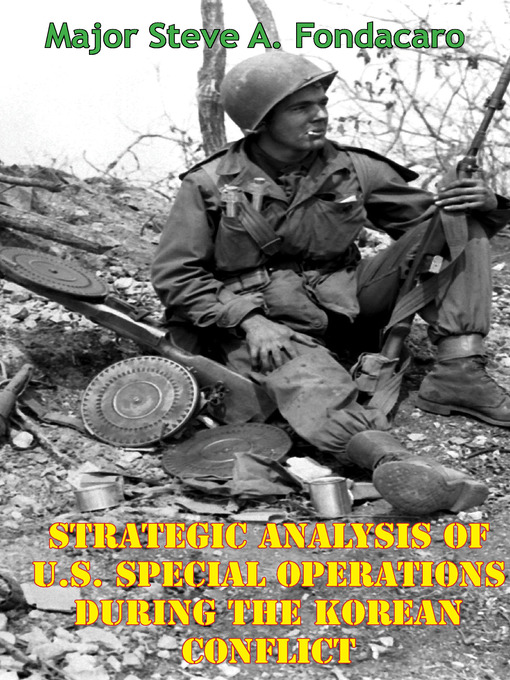
Title details for Strategic Analysis of U.S. Special Operations During the Korean Conflict by Major Steve A. Fondacaro - Available

Strategic Analysis of U.S. Special Operations During the Korean Conflict

ebook
This study analyzes the strategic effectiveness of special operations conducted by the Far East Command (FECOM) and the Central Intelligence Agency (CIA) in Korea during the Korean Conflict from 1950 to 1953. Each organization's effectiveness is determined by examining the areas of strategy, organization and operations. Special operations as defined in Joint Chiefs of Staff Publication Number 2, Unified Action Armed Forces (UNAAF) was the standard by which operations were selected for examination. The study answers four questions: 1) What were the U.N. Command strategic objectives within the Korean theater, and how did these change? , 2) How these changing strategic objectives development and coordination of special operations objectives, forces and headquarters?, 3) What did U.S. special operations in Korea accomplish strategically? 4) What conclusions can be drawn from U.S. special operations forces' effectiveness or ineffectiveness in Korea? FECOM special operations were limited to partisan operations and psychological operations. The partisans consisted of anti-communist North Koreans organized and led by U.S. cadre beginning in January, 1951. Psychological operations were conducted continuously from July, 1950 by a separate staff element whose capabilities expanded dramatically during the course of the conflict. CIA operations within Korea consisted of intelligence gathering and special (or covert) activities controlled from headquarters in Japan. CIA operations remained autonomous of FECOM control throughout the conflict. The control issue was the source of bureaucratic conflict that inhibited operational coordination between FECOM and CIA throughout the conflict.
  • Creators

  • Publisher

  • Release date

  • Formats

  • Accessibility

  • Languages

Formats

  • Kindle Book
  • OverDrive Read
  • EPUB ebook

subjects

Languages

  • English