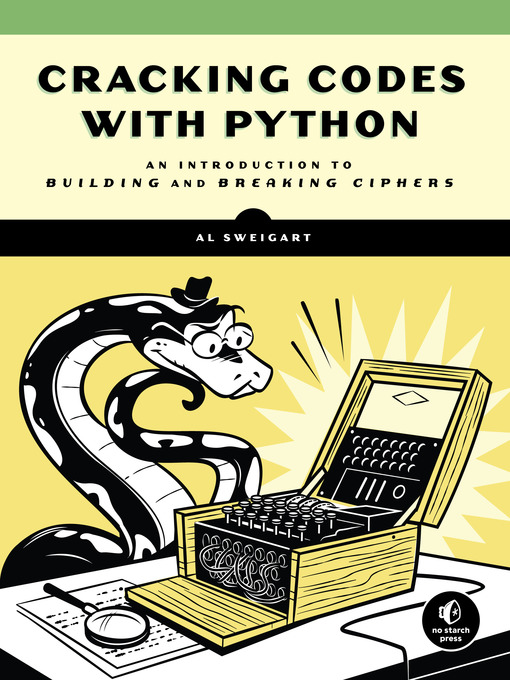
After a crash course in Python programming basics, you’ll learn to make, test, and hack programs that encrypt text with classical ciphers like the transposition cipher and Vigenère cipher. You’ll begin with simple programs for the reverse and Caesar ciphers and then work your way up to public key cryptography, the type of encryption used to secure today’s online transactions, including digital signatures, email, and Bitcoin.
Each program includes the full code and a line-by-line explanation of how things work. By the end of the book, you’ll have learned how to code in Python and you’ll have the clever programs to prove it!
You’ll also learn how to:
- Combine loops, variables, and flow control statements into real working programs
- Use dictionary files to instantly detect whether decrypted messages are valid English or gibberish
- Create test programs to make sure that your code encrypts and decrypts correctly
- Code (and hack!) a working example of the affine cipher, which uses modular arithmetic to encrypt a message
- Break ciphers with techniques such as brute-force and frequency analysis
There’s no better way to learn to code than to play with real programs. Cracking Codes with Python makes the learning fun!
-
Creators
-
Publisher
-
Release date
January 23, 2018 -
Formats
-
Kindle Book
-
OverDrive Read
- ISBN: 9781593278694
- File size: 19995 KB
-
EPUB ebook
- ISBN: 9781593278694
- File size: 20302 KB
-
-
Accessibility
-
Languages
- English
-
Levels
- Lexile® Measure: 1150
- Text Difficulty: 8-9
Formats
- Kindle Book
- OverDrive Read
- EPUB ebook
subjects
Languages
- English
Levels
- Lexile® Measure:1150
- Text Difficulty:8-9
Why is availability limited?
×Availability can change throughout the month based on the library's budget. You can still place a hold on the title, and your hold will be automatically filled as soon as the title is available again.
The Kindle Book format for this title is not supported on:
×Read-along ebook
×The OverDrive Read format of this ebook has professional narration that plays while you read in your browser. Learn more here.